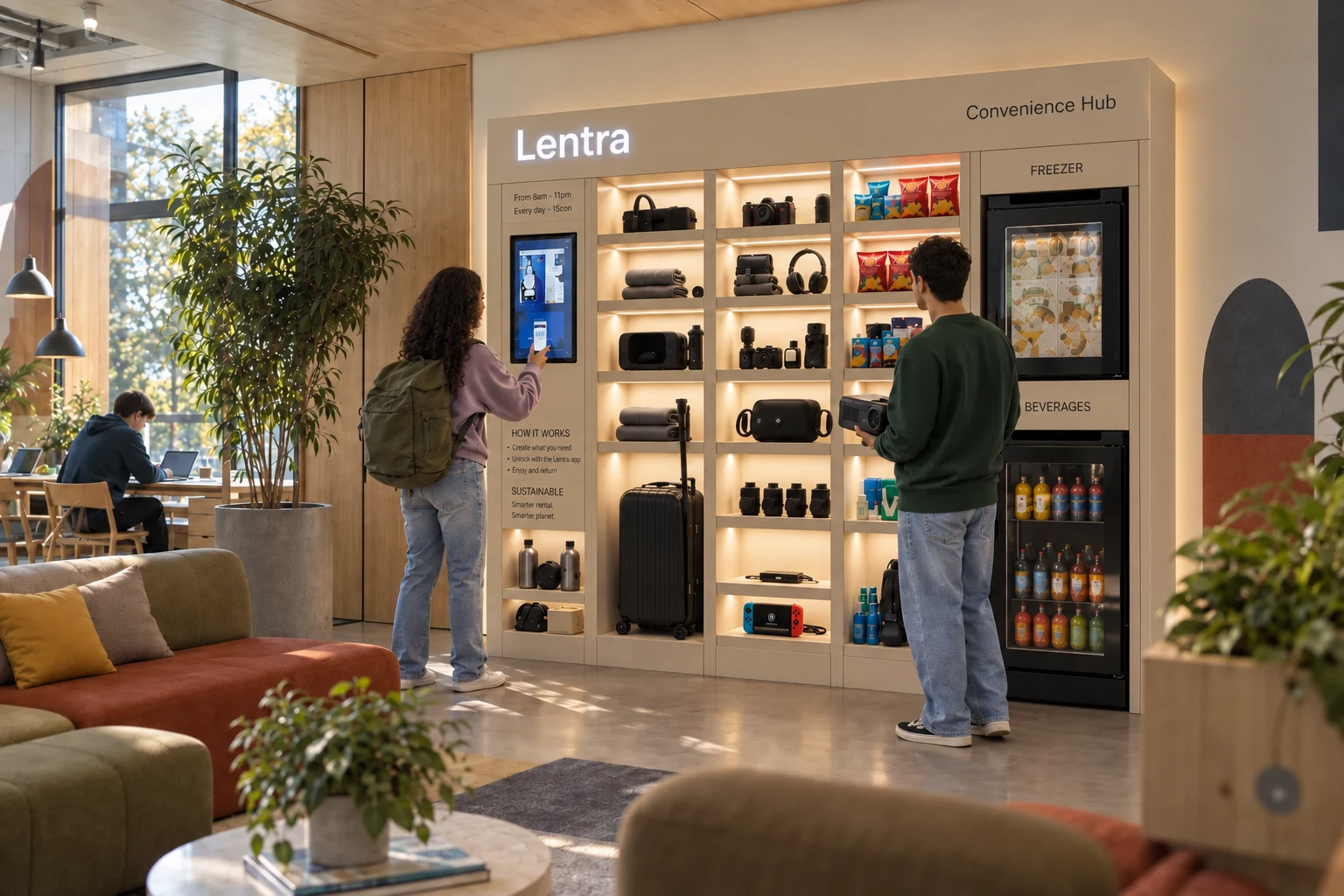
Share products that do not belong in every room
Student households often have limited storage and residents may move frequently. Shared vacuums, carpet cleaners, printers, projectors, games equipment and event items can be more practical than asking every resident to buy the same product. Lentra gives each item a defined compartment and an app-based reservation, access and return journey.
Support move-in, everyday living and community activity
The strongest assortment usually covers more than one moment. Cleaning and household products help during move-in and inspections. Printing and scanning support study. Speakers, projectors and games can support communal activity. A compact shop can cover selected essentials outside nearby retail hours. The exact mix should reflect the property rather than a generic student checklist.
Keep responsibility away from reception handovers
Traditional loan cupboards create recurring tasks: storing keys, checking items, recording who borrowed what and dealing with late returns. A managed locker workflow can automate routine access and retain a transaction record. Operators should still agree how damages, accessibility needs, support and exceptional returns are handled so technology does not become a dead end.
Design for high turnover and changing demand
Student populations change each year, and a useful amenity should be able to change with them. Early product choices can be reviewed against usage, support requests and resident suggestions. New categories can be tested in a controlled way, while products that are hard to maintain or rarely requested can be replaced rather than occupying permanent space.
Evaluate service quality, not novelty
A locker wall is only useful when products are available, maintained and easy to access. Track repeat usage, out-of-service time, replenishment, support response and the questions residents ask. These measures help the accommodation team decide whether the service is genuinely reducing friction for students.