Redefining how the world accesses convenience.
We think the everyday things people need should be a few steps away and available the moment they are needed, not owned, stored and maintained by everyone separately. Lentra builds the hub that makes that true in a single building.
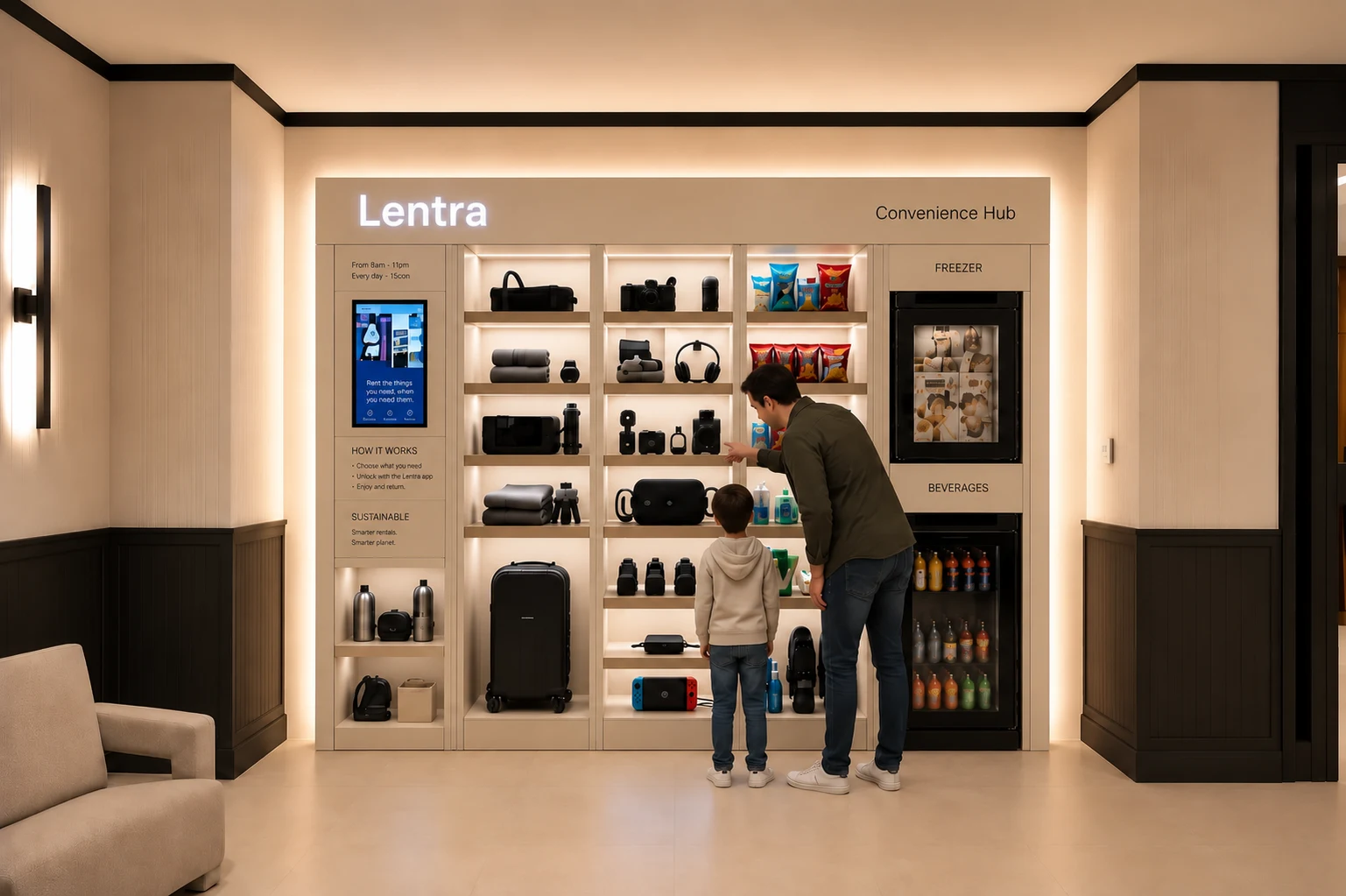
More done, with fewer burdens
Ordinary life is full of small frictions that each cost an hour. Running out of something at ten at night. Needing a tool for forty minutes. Realising at midnight that the flight is at six and the adapter is in a drawer somewhere else. None of these are hard problems. They are just badly solved, over and over, by everyone independently.
Lentra's answer is a hub in the building, stocked with the things people actually reach for, open whenever they need it. Take what you need, return it when you are done. No ownership, no storage, no maintenance, no trip.
That is the whole idea, and it scales further than one lobby. Anywhere people gather for long enough to have routines, the same frictions exist and the same fix works.
The things people actually reach for
Not a vending machine and not a catalogue. A selection chosen for the building it sits in, available on demand and returned when the job is done.
Tools and equipment
Drills, ladders, steamers, the vacuum nobody wants to store. Borrowed for the afternoon rather than bought for the decade.
Wellness essentials
The things people need at the moment they need them, from pain relief to a thermometer, without a trip to a pharmacy that closed at six.
Travel gear
Luggage, adapters, garment bags and the rest of the kit that gets used twice a year and takes up space for the other three hundred and sixty days.
Everyday staples
Detergent, batteries, coffee, the small things that run out at exactly the wrong hour. Bought, not borrowed, and always in stock.
The mix is set per building and reviewed against real usage rather than fixed at launch. What a student residence reaches for is not what a hotel reaches for.
Four settings, one idea
Residences, student housing, offices and hotels look like different businesses. They share a problem: people who need something small, right now, and have no good way to get it.
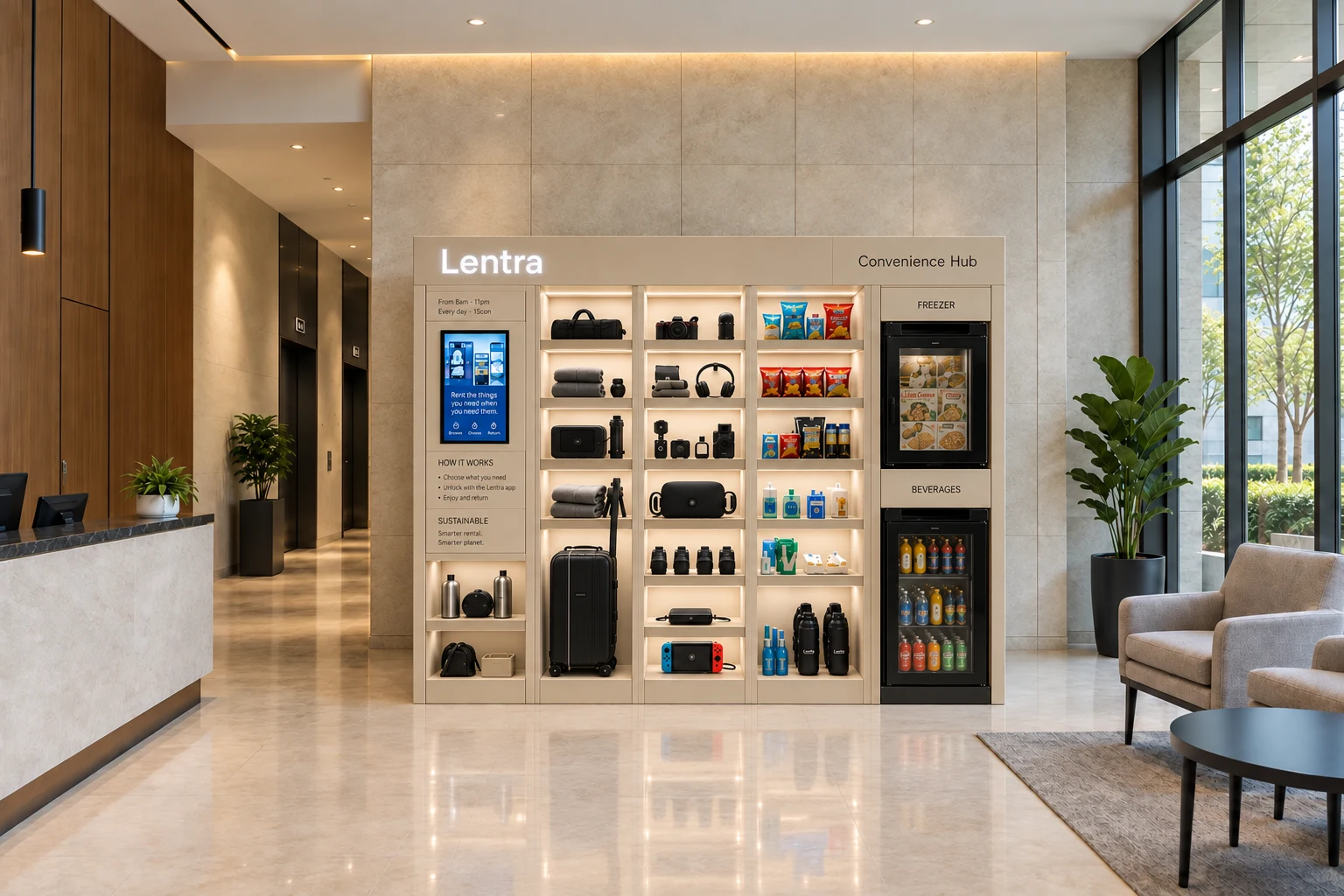
Residences
Home is where the cost of ownership quietly piles up. A hundred households in one building, each buying the same drill, the same steamer, the same suitcase, each using it twice a year. A building is exactly the right size to fix that.
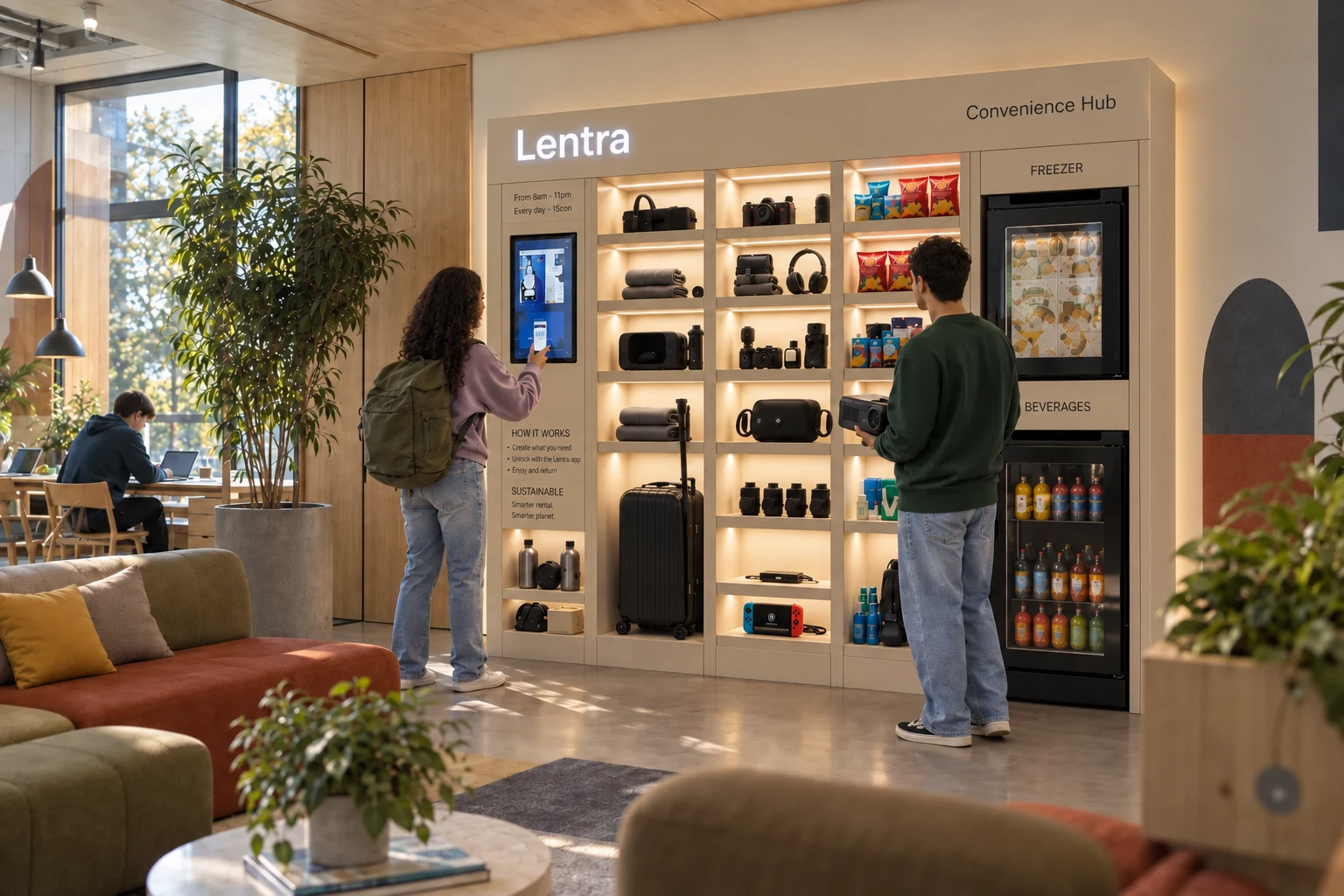
Student housing
The people with the least space, the tightest budgets and the most one off needs. Buying a printer for one semester is a bad trade, and everyone makes it anyway. Borrowing it for an afternoon is the obvious answer and almost nobody offers it.
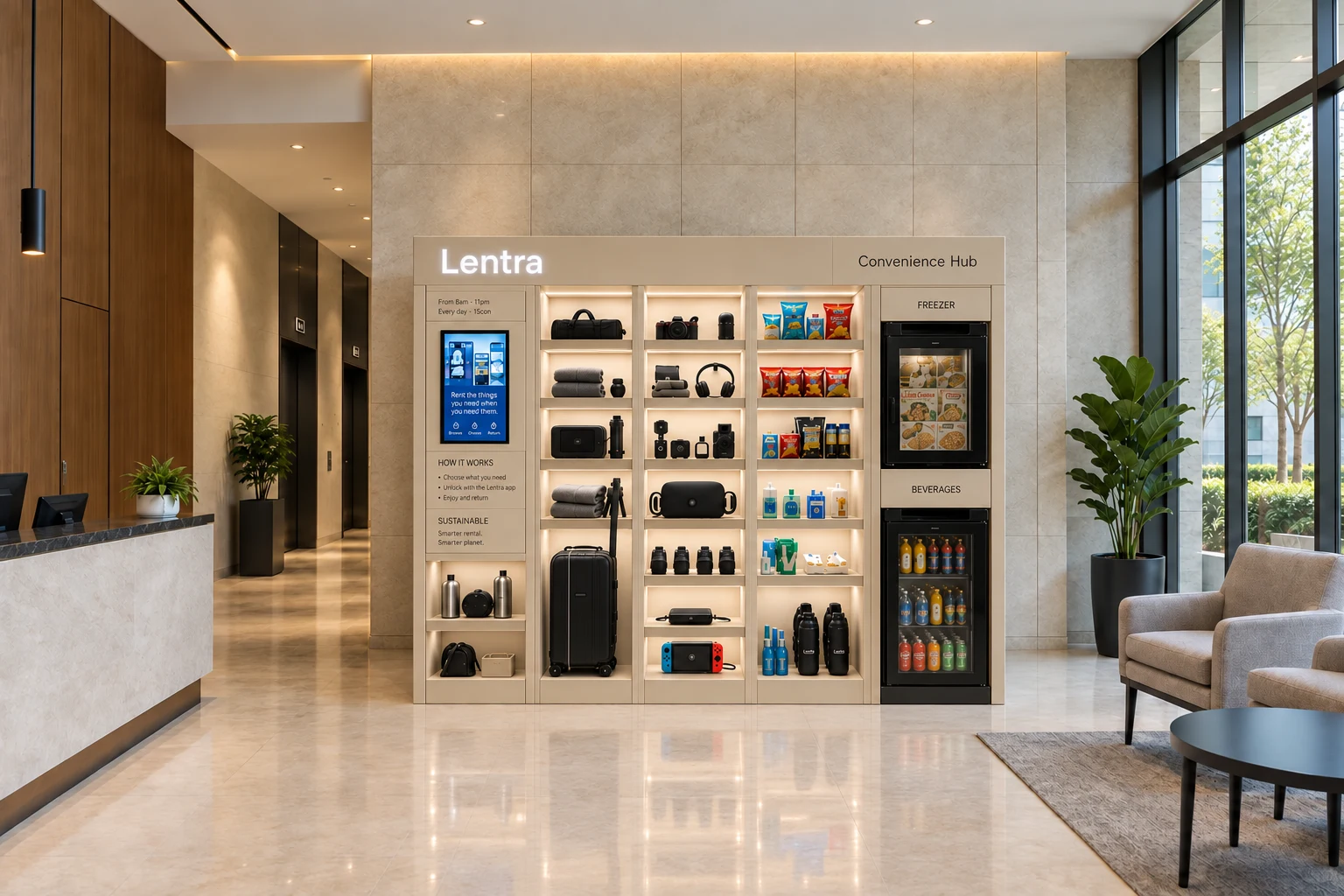
Offices
The working day does not stop at the desk. A charger, a headache tablet, a clean shirt before a meeting nobody warned you about. Small failures that cost an hour each and are trivially solvable forty steps away.
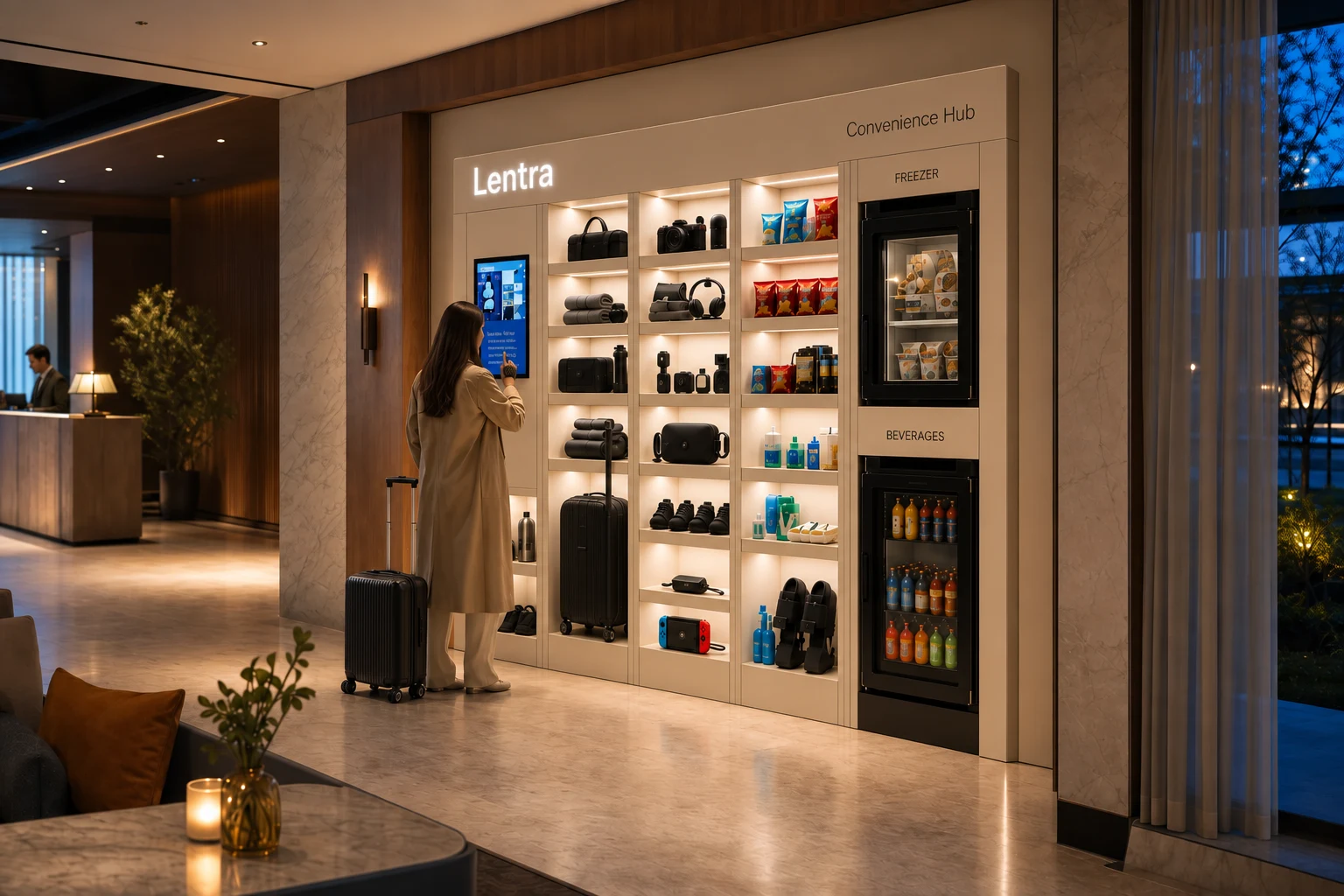
Hotels
Guests arrive without the one thing they forgot, usually after midnight. A front desk cannot stock everything and should not have to be awake to hand it over. Self service at any hour is simply a better answer for both sides.
Once people have it, they will not go back
Convenience is asymmetric. Adding it is pleasant. Taking it away is not.
A resident who has spent a year borrowing what they need from the lobby has quietly reorganised how they live. They stopped buying the thing they needed twice. They stopped keeping a spare of everything. They stopped planning a Saturday around one errand.
When that resident looks at another building, the comparison is no longer feature against feature. It is their current normal against going back to the way things were, and going back reads as a downgrade even when the rent is lower.
That is also why the selection matters more than the cabinetry. Buying one good vacuum for a building costs less than a hundred households each buying a mediocre one, so residents get the version they would never have bought for themselves, for the price of a short rental, always charged and ready.
And it gets better with use
The software reads what is used, what is reserved and never collected, what residents ask for and cannot find, and what has sat untouched for a quarter. That becomes a running recommendation: stock more of this, retire that, add the thing people keep requesting.
Curation stops being a launch decision and becomes an operating habit. The hub in month twenty fits the building better than the hub in month one did.
How the software does itPractical beats aspirational
The NMHC and Grace Hill Renter Preferences Survey is the most comprehensive study of its kind in the sector, built on 172,703 verified renters across 4,220 communities in 77 markets. The features that came out on top were the everyday ones: in unit laundry and air conditioning at 93 percent each, high speed internet at 90 percent, reliable mobile reception the community amenity most often called very important at 86 percent.
Every item on that list is something a resident touches daily and misses immediately. None of it is brochure material. We read that as a straightforward signal about where amenity budgets are best spent, though we should be clear that the survey did not ask about convenience hubs and says nothing about us directly.
Read our full write-up of the survey- 172,703verified renters surveyed
- 93%rate in unit laundry important, tied with air conditioning
- 90%rate high speed internet access important
- 86%call reliable mobile reception very important
Source: 2024 NMHC and Grace Hill Renter Preferences Survey Report.
Clear responsibilities from proposal to operation
Building-specific design
The footprint, finishes, product categories and access flow are planned around the actual property rather than a generic locker package.
Managed operation
Software, resident access, support, maintenance and the agreed replenishment workflow stay connected after the installation goes live.
Measured iteration
Usage and resident requests drive the review. Slow moving items get reconsidered and recurring needs shape what comes next.
Claims should be as specific as the building
Hub performance depends on the property, resident mix, product selection, pricing and operating model. Lentra proposals separate assumptions from contractual terms and explain who owns the equipment, who keeps revenue and who handles recurring work.
We publish customer names, testimonials and measured outcomes only when they can be attributed and the customer has approved publication. Until then, our public resources focus on the decisions property teams can verify for themselves.
What to ask in any convenience hub proposal
- 01 Which resident need does the service solve?
- 02 Who owns, stocks and maintains each component?
- 03 Which figures are estimates and which are contractual?
- 04 How are support, accessibility and exceptions handled?
- 05 How can the offer change when demand changes?
Tell us what your building needs
We will map the space, service model and resident offer into a proposal with clearly labeled assumptions.