Convenience, run as infrastructure.
Lentra puts a stocked, software-operated convenience hub inside the buildings where people already are, and runs it end to end. The hardware gets us into the lobby. The software is the business.
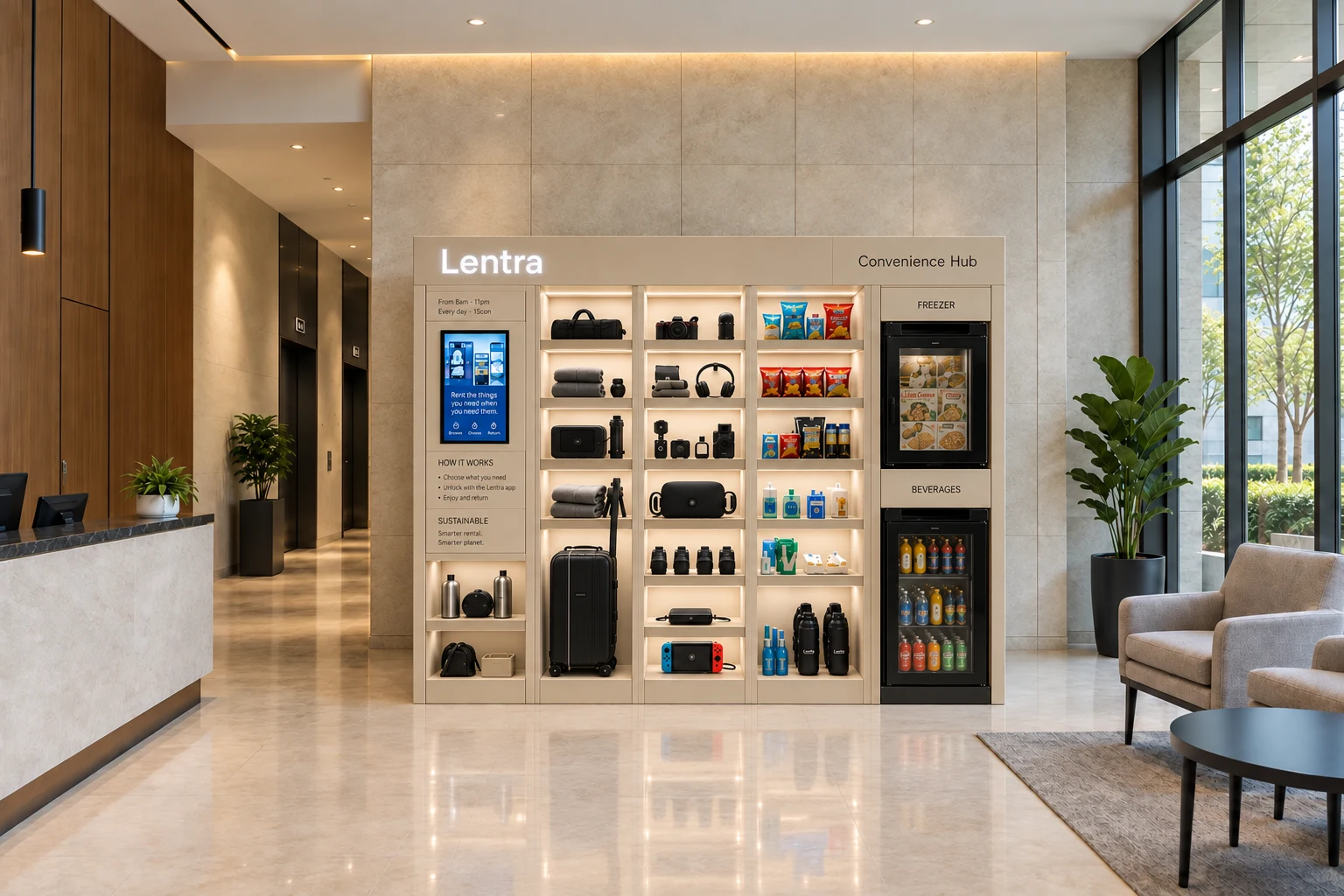
Ownership is being unbundled, one category at a time
Music, transport, tools, workspace, film. In category after category, a generation has swapped owning for access, and has not gone back. The physical objects in a household are the largest category that has not been unbundled yet, because nobody solved the last hundred metres.
Renting a drill by post is slower than buying one. A shared cupboard needs somebody to run it. Both fail for the same reason: the thing has to be within reach at the moment the need appears, or the need gets met by a purchase instead.
A building is the unit where that stops being true. A hundred households in one structure share a lobby, a delivery flow and a set of repeated needs. Put the inventory there, run it with software, and the distance between wanting something and having it collapses to a walk down a corridor.
Four things that were not true five years ago
The behaviour is set
Access over ownership stopped being a preference and became a default. The people signing leases now have never organised their lives around accumulating things.
Lobbies are already logistics
Parcel volume forced buildings to accept that goods arrive and wait. The hard conversation about giving up lobby floor area has already happened.
Amenity budgets are under review
Gyms and lounges cost floor area and get used by a fraction of residents. Operators are looking for features that survive a spreadsheet.
The stack got cheap
Smart locks, cellular connectivity, payments and app distribution are commodities now. The differentiator moved from the hardware to what you do with the data it produces.
Four lines, two of them recurring
The build is a one-off. The rest repeats, and the repeating part is what compounds as installations accumulate.
Rentals
Residents pay per use for tools, equipment and gear they would otherwise buy. Recurring by nature: the need repeats, the asset does not have to.
Retail
Everyday staples sold from the same hub at the hour people actually run out, with no staffed alternative in the building.
Software plan
A monthly per-installation fee for access control, payments, inventory, the resident app, reporting and support routing. The recurring line that does not depend on footfall.
Build
Under Self-Owned, a one-time hardware and installation charge. Under Fixed Rent, Lentra funds the build and pays the property rent for the space instead.
Lentra owns the asset
We fund, own, stock and operate the hub and pay the property at or above the market rent for the footprint, weighted so the smallest footprints earn the biggest premium. Capital sits on our side; so does every revenue line. The property's decision has no capital in it, which removes the slowest objection in the sale.
- CapitalLentra
- RevenueLentra
- Property receivesFixed monthly rent
- Sales frictionLowest
The operator owns the asset
The operator buys the build and keeps rental and retail revenue. Lentra keeps the software plan and the service relationship. Cash comes forward, the recurring line stays, and no balance sheet of ours is consumed to grow.
- CapitalOperator
- RevenueOperator, less the software plan
- Lentra receivesBuild plus monthly plan
- Capital efficiencyHighest
Carrying both models is deliberate. One removes the capital objection, the other removes the control objection, and between them very few reasons to say no are left standing.
The lockers are the distribution. The software is the company.
Anyone can buy compartments. What is hard to assemble is an operating system for a physical amenity, and the record of how real buildings actually behave that it produces.
The selection is learned, not listed
Every rental, purchase, reservation and unmet request is counted against the building it happened in. A competitor can copy the cabinetry in a quarter. The record of what a specific building reaches for takes as long to build as it took us.
Switching means ripping out a lobby
Once a hub is fixed, powered and networked into a building, and residents have organised their week around it, replacing it is a construction decision rather than a procurement one.
The software runs on other people's hardware
The platform can operate lockers already installed, subject to what their controllers expose. That turns an installed base owned by someone else into a distribution channel rather than a competitor.
Two ways to say yes
Fixed Rent removes the capital objection; Self-Owned captures operators who want the upside. Most competitors offer one, which means one reason to be turned down.
Four segments, one installation
The same hub, software and service model sell into residences, student housing, offices and hotels. That matters commercially more than it sounds: the product does not have to be rebuilt to enter the next segment, so each new vertical is a sales motion rather than a development cycle.
It also smooths the demand curve. Student housing buys on a September cycle, hotels on refurbishment cycles, offices on lease events, residences on handover. Four clocks, not one.
What we measure, and what we will show you
The current values are not published here. They are in the deck and the data room, at the stage of the conversation where they can be discussed properly rather than screenshotted.
- Monthly and annual recurring revenue
- Revenue by line: rentals, retail, software plan, build
- Installed hubs and compartments under management
- New buildings per quarter, and by segment
- Gross revenue retention by building
- Net revenue retention including expansion into further buildings
- Weekly active residents as a share of units
- Repeat use per active resident
- Customer acquisition cost and payback period
- Lifetime value to acquisition cost ratio
- Burn multiple: net burn against net new recurring revenue
- Contribution margin per installation, after stock and service
- Availability and uptime per installation
- Support volume per hundred residents
- Stock turns and shrinkage
- Time from signed scope to live
Installed base, revenue by line, retention and unit economics are deliberately blank rather than estimated. An investor page with invented traction on it is worse than one with none: it is the first thing diligence checks, and the first thing that ends a conversation.
What the capital is for
Three things take money in this business, and they are worth separating because they behave differently. Building inventory under Fixed Rent is an asset purchase and should be financed like one. Engineering on the platform is the durable spend. Going into a new market is a fixed cost paid once per country.
Stage, instrument, size and the split between those three are in the deck, along with what each unlocks and what happens if only part of it is raised.
Where it goes
- Hardware and stock Funding installations under Fixed Rent, where Lentra owns the asset and earns every line.
- Platform engineering The learning loop, operator reporting, integrations and running on third-party lockers.
- Market entry Per-country setup: language, payments, logistics, service coverage and the first reference buildings.
- Commercial team Named-account coverage of operators and developers with portfolios rather than single buildings.
Who is actually building this
This section is left blank on purpose. Founder names, what each of you did before, and which four hires the round funds are the parts an investor reads first, and they have to be yours rather than drafted for you.
Worth including when you fill it: what you have each shipped before, why this team is the one that gets a physical and software product into buildings, and who is not on the team yet.
Founders and key hires go here
Photograph, name, role, one line of history each. Nothing invented for this preview.
The data room is staged, not gated
Company and commercial material opens on the first call. Financial detail, contracts and the cap table open once there is interest on both sides. Nothing is withheld that you would need to form a view.
Ask for anything that is not on that list. If it exists, you get it; if it does not exist yet, we will say so rather than build it overnight.
Four questions, then the deck
Investor questions
Is this a hardware business or a software business?
Which model do you push, Fixed Rent or Self-Owned?
What stops an operator building this themselves?
How capital intensive is this?
What are the real risks?
Can we talk to your customers?
What is the exit thesis?
Important
This page describes Lentra and its business for information only. It is not an offer to sell, or a solicitation of an offer to buy, any security or other financial instrument, and it is not investment advice or a recommendation. Any investment would be made solely on the basis of definitive documentation and the information provided in diligence, not on the basis of this page. Forward-looking statements reflect current intentions and assumptions, which may change, and actual outcomes may differ. Nothing here has been reviewed or approved by any regulator.
Placeholder in this preview: this wording is a starting point and has not been reviewed by counsel. Have a lawyer check it against the jurisdictions you will be approaching investors in before this page goes live.
Want to see the numbers
Four questions and you have the deck. Press on whichever part of it you think is weakest.