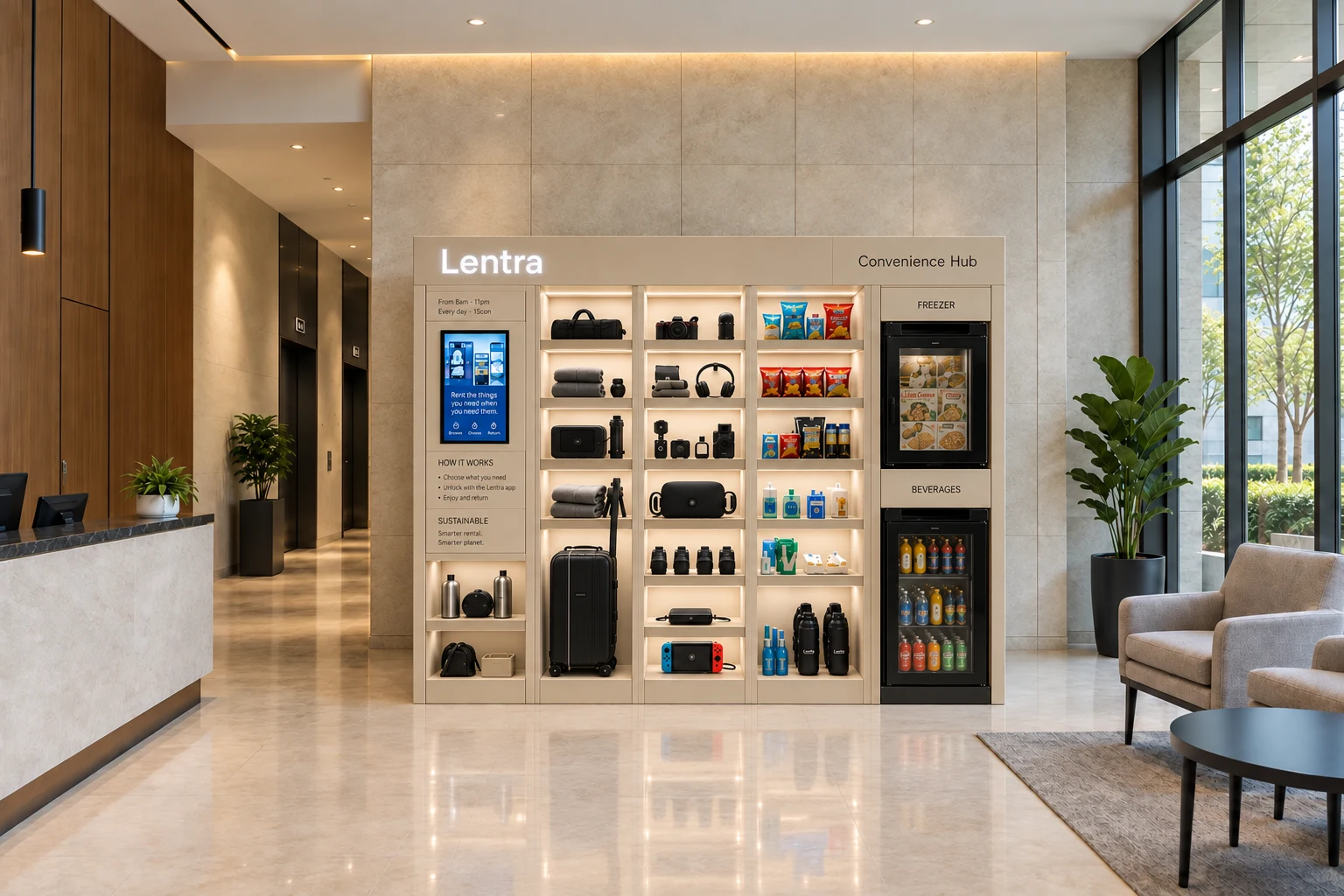
Solve recurring resident needs close to home
Apartment amenities often compete for space and operating attention. Lentra focuses on practical moments that occur throughout the week: borrowing a cleaning tool, collecting a household essential, reserving a projector or printing a document. Residents use the app to find an item, pay or reserve when required, open the assigned compartment and return reusable products through the same service.
Use lobby space without creating another staffed desk
The physical footprint is planned around circulation, accessibility, fire and building requirements, then finished to suit the property. Because common transactions are self-service, a property team does not need to manage keys or manually hand over every product. Support and exception handling should still be defined in the proposal so residents know where to go when something does not work.
Choose an operating model deliberately
Under a fixed-rent arrangement, Lentra owns and operates the amenity and the building provides the agreed space. Under a self-owned arrangement, the operator owns the installation and inventory and keeps its revenue while Lentra supplies the technology and agreed operating services. Rent, build cost, software terms and projections are property-specific; public descriptions should not be treated as contractual figures.
Plan the assortment around the building
A resident profile, unit count, nearby retail, existing amenities and available storage all influence the initial mix. A building with many compact apartments may prioritize cleaning and hosting products. A family-oriented property may choose different household, leisure or event equipment. Usage and resident suggestions then provide evidence for reviewing slow-moving and frequently requested categories.
Measure utility before making outcome claims
Direct usage, availability, support requests and repeat demand are easier to verify than broad promises about retention or rent premiums. Property teams can also monitor resident feedback and operational workload. This creates a more useful evaluation: whether residents use the service, whether responsibilities are clear and whether the chosen footprint earns its place in the building.