What happens after the sale
Units sold is a single binary yes, collected once, with no context around it. Everything that actually determines whether a product was any good happens after that moment, where almost nobody is looking.
Think about what a company actually learns when someone buys its product. One thing: that at one moment, a person said yes instead of no. That is the entire signal. The relationship has its only point of contact at the till, and then it goes quiet.
Everything that would tell you whether the product was worth making happens after that. Was it opened. Was it used. Was it used twice. Did it become part of someone's week, or did it go into a drawer and stay there. None of that comes back. The company counts the yes, books the revenue, and calls it a success.
A units-sold figure cannot tell these two things apart
Two products, same category, same price, same number sold this quarter.
- The first was bought, used within a day, used again the following week, and has been picked up roughly twice a month ever since. It has quietly become the thing people reach for without thinking about it.
- The second was bought on the strength of the packaging, tried once, found slightly annoying, and never touched again. Nobody complained, because it was not broken. It was just not quite good enough to come back to.
On the only metric either company has, these are identical products. One of them deserves a second version and more shelf space. The other deserves a rethink. Nothing in the sales data distinguishes them, and the team working on the second one will spend the next cycle optimising a thing people quietly abandoned.
One metric is easy to misread, and easy to misrepresent
The second problem with a single number is that it is so easily pointed in a flattering direction. Sales spiked: was that the product, the discount, the shelf position, the season, or a competitor going out of stock. A number with no context can be attached to whichever story the person presenting it prefers, and there is nothing in the data to argue back.
Layers of behaviour are much harder to spin. If the claim is that people love it, then first use should be fast, second use should follow, and the interval between uses should settle rather than stretch out. If those three do not hold, the story does not survive the follow-up question. Multiple signals that have to agree with each other are a kind of honesty constraint that a single figure never imposes.
What an operated hub sees that a shop cannot
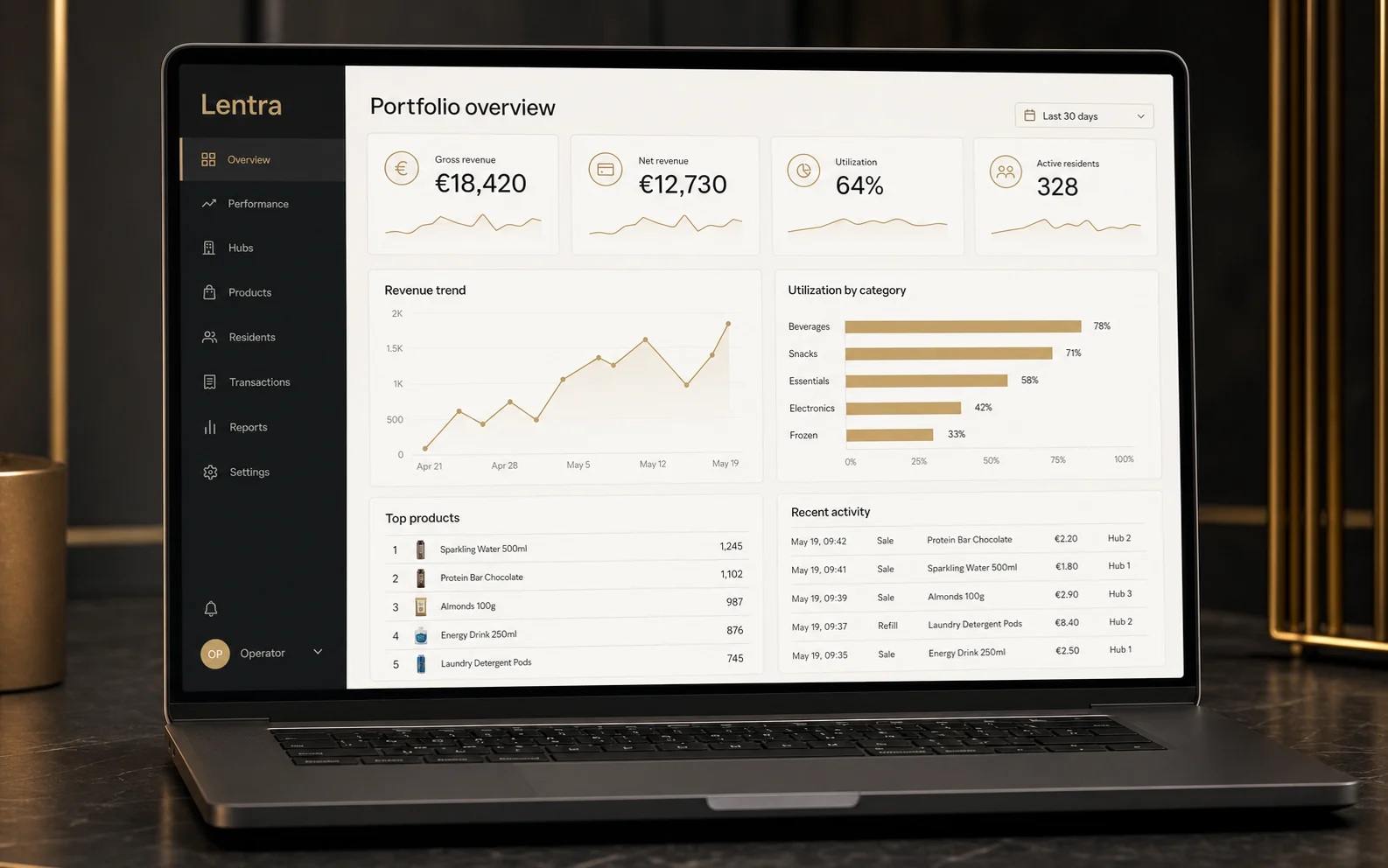
A convenience hub is unusual in one specific way: things come back. Rentals return, compartments report, the app records the whole arc rather than the purchase moment. That produces a continuous signal instead of a single event.
- Time to first use. Same day, or three weeks later, or never.
- Whether there was a second time, which is the single most informative number in the set.
- Cadence. Daily, weekly, monthly, or a slow drift toward nothing.
- Duration. Forty minutes suggests a job. Four days suggests it moved in.
- Whether it became a staple, meaning the interval stabilised rather than lengthened.
- What was asked for and was not there, which is demand nobody else ever sees because it never became a transaction.
None of this requires anyone to fill in a survey or rate anything out of five. It is what people did, counted.
What that changes, in practice
Three things, in roughly this order.
Prices move toward what gets used. In every building, volume concentrates in a small set of items. Knowing which ones, in this building, is what makes it possible to price them down rather than spreading a thin margin across a catalogue where most of it never moves.
Dead lines get retired. A compartment holding something nobody has touched in a quarter is floor area doing nothing. It gets replaced, preferably by something residents have been asking for and not finding.
The people who made the product find out what happened to it. This is the part that surprises manufacturers, because almost nothing in their existing reporting answers it. We can tell them which products turned into habits, which were tried once and dropped, and roughly where the drop-off sits. That is a better brief for the next version than a units-sold figure has ever been.
We will share it
This is a standing offer rather than a marketing line. Companies whose products we stock, suppliers we buy from, and brands we curate into the selection can ask us what happened to their products in our buildings, and we will tell them, on a regular basis rather than once when it suits us.
The reasoning is not charitable. Better products get used more, which is the thing our entire model runs on. A supplier who learns that their steamer is abandoned after the third use, and fixes whatever causes that, has made our hubs more useful. We are one of the few places in the chain that can close that loop, and keeping it shut would be a strange thing to do with it.
The two limits on that
First, anything that leaves Lentra is aggregated and anonymised. A supplier learns that a category is picked up twice a week and abandoned after the third try. They do not learn who, which flat, or anything that could be walked back to a person. Resident-level data stays with the resident's own account and the terms written into the building's contract, and no commercial conversation changes that.
Second, the system counts what happened, not why. It can tell you that use of something fell off a cliff in week three. It cannot tell you whether that was the product, the weather, a broken compartment or a resident moving out, and we would rather hand over the shape of the drop and let you investigate than invent a cause that sounds convincing.
Why this matters more than it sounds
The whole consumer goods chain runs on a signal that arrives once, at the worst possible moment for learning anything, and then stops. Everyone downstream of it is making decisions about products they cannot see being used. A model where the object comes back is a rare chance to fix that, and it seems worth doing properly.
See what your building actually uses
The reporting is part of every installation. So is the standing offer to share what we learn.