The definition, in one paragraph
An amenity delivered as a service is one where a third party carries the capital cost, the inventory, the software and the recurring operating work, while the building contributes space and a commercial agreement. It is the same shift that took software from a licence to a subscription and vehicles from a purchase to a lease, applied to the physical services a building offers the people inside it. There is a simple test for whether a proposal really is one: after handover, when something breaks, runs out or needs replacing, whose job is it?
Why the model appeared
Amenity budgets have been climbing while certainty about the return has not. A gym, lounge or coworking room is committed years before anyone knows how a building's residents will actually behave, and once it is built it is expensive to change your mind. At the same time the people using the building are increasingly used to reaching things rather than owning them, the same expectation that made car clubs, tool libraries and subscription everything normal. Delivering an amenity as a service moves both the capital risk and the flexibility problem to the party better placed to carry them.
What it changes for the property team
Four things, mostly. The spend moves from a capital project to a commercial agreement, which changes who has to approve it and how it is judged. The building contributes space rather than budget, which makes a compact footprint far easier to justify than a room. Every recurring task, stocking, cleaning, repairs, payments, resident support, has a named owner outside the on-site team. And because a service can be changed, the offer is allowed to evolve as the building's demand becomes clear, instead of being frozen on opening day.
What it does not change
The space is still yours, the residents are still yours, and it is still your building's reputation on the line when the service is poor. Amenity as a Service is not a way to stop caring about an amenity; it is a way to stop staffing one. Service levels, the escalation route, response times and the review cadence deserve to be specified as precisely as they would be in a cleaning or lift-maintenance contract, and for exactly the same reason.
How to evaluate a provider
Ask for five things in writing. A responsibility matrix naming who does each recurring task. A clear statement of who funds the build and who owns the equipment and the inventory. A separation of the figures that are contractual from the ones that are projections, with the inputs behind the projections shown. Service levels with response times, and what happens outside office hours. And exit terms: what happens at the end of the term, who removes the installation, and what becomes of the stock. A provider who has thought about the last one has usually thought about the rest.
Where the value shows up for the asset
Some of it is measurable and some of it is not, and a serious provider will tell you which is which. Measurable: how often residents use it, how often the thing they wanted was available, how many support requests it generated, what it earned. Not directly measurable, but real: a building that shows better on a viewing than the four others someone sees that day, an amenity residents mention when a friend asks where they live, and a lobby that gets a reaction from guests, brokers and investors on the way in. Treat the first list as reporting and the second as positioning, and do not let anyone sell you the second as though it were the first.
Where Lentra fits
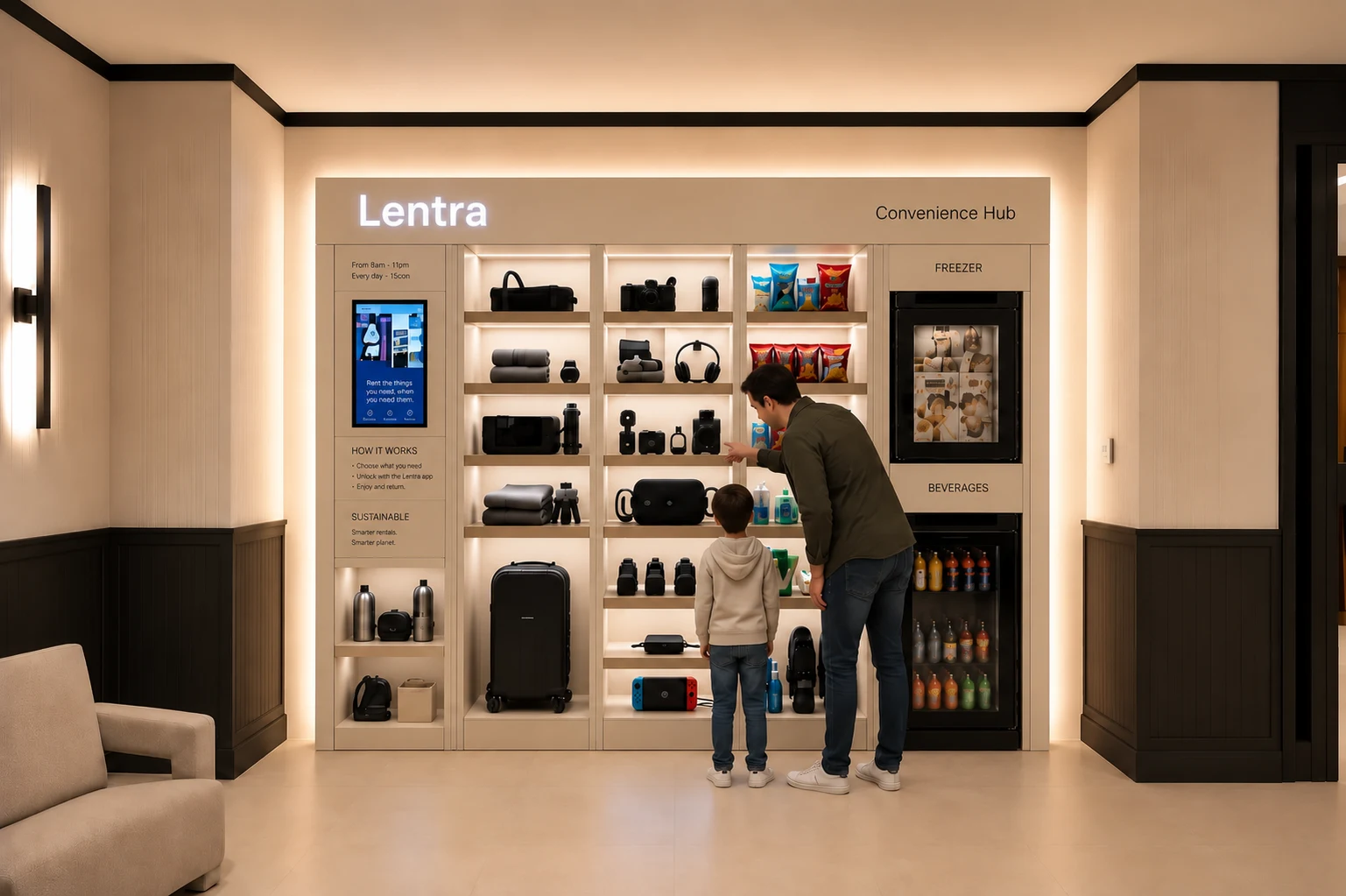
Lentra is one implementation of the model: a designed smart-locker wall in the lobby, a curated mix of rentals and everyday essentials, a resident app for access and payment, and an operating team behind all of it. Under Fixed Rent, Lentra funds and owns the amenity and the building receives an agreed monthly rent for the space. Under Self-Owned, the building funds a one-time build and a software plan and keeps what the amenity earns. Both are set out per property, and both name every operating responsibility before anything is installed.